Study Centre · The basics
A still tortoise is not necessarily lazy. Its relationship with temperature helps explain when it moves, eats or seeks shelter.
In brief
To understand behaviour, look at the environment too: the same animal may behave differently as conditions change.
What “ectothermic” means
Tortoises obtain much of the heat that regulates their body temperature from the environment. This is why they are called ectotherms. The expression “cold-blooded” can be misleading: a tortoise in the sun is not necessarily cold. Temperature, metabolism and digestion are connected. [1]
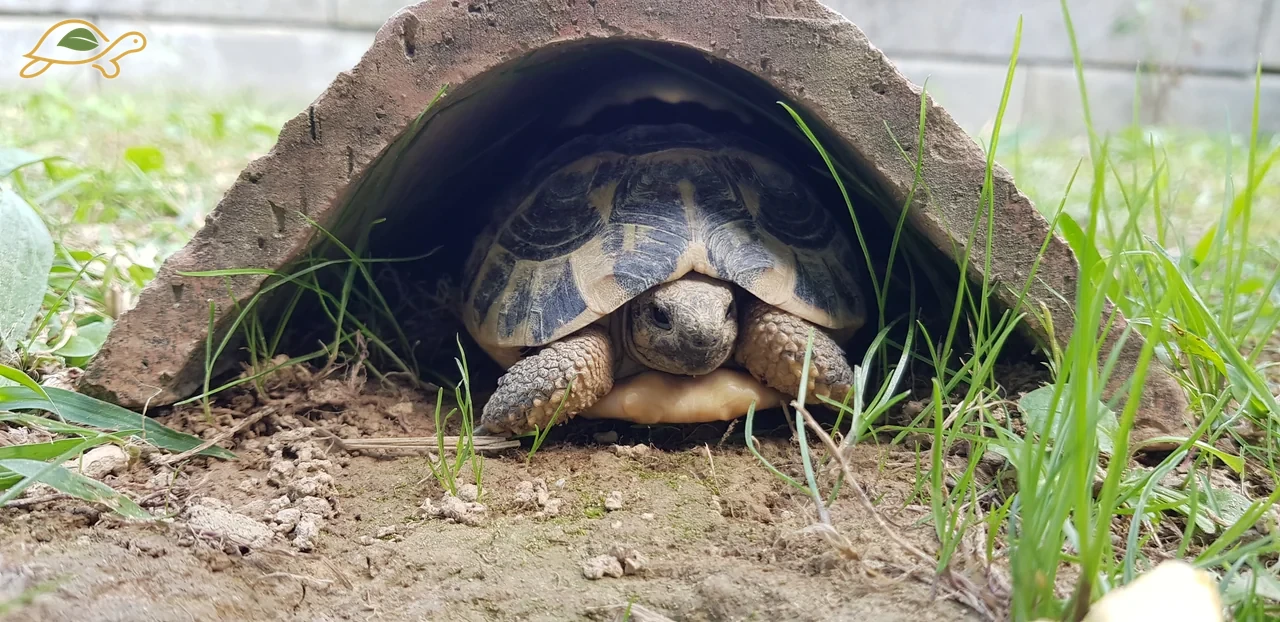
Imagine watching a day from a distance: an animal emerges, stays in the light, then moves away. Counting how many minutes it walks is not enough to understand its condition. We also need to ask what is happening around it.
A day does not follow a fixed timetable
Alternating between basking, foraging and shelter allows an animal to use different conditions. Activity also changes with weather and season. There is therefore no single “right” timetable for every tortoise in every place. [1]
Observing does not mean forcing: moving an animal every time it enters shade prevents us from understanding its choice. What matters is the relationship between behaviour and the opportunities the space offers.
Light and heat are not the same thing
An environment may look bright without providing the conditions a reptile needs. Temperature, ultraviolet light, humidity and the ability to move between different areas are distinct aspects of husbandry. Equipment also needs to be selected and installed appropriately for the species: more power does not mean better welfare. [2]
A short observation exercise
Without disturbing the animal, note the time, weather, area occupied and visible activity. Write “it is under the shelter”, not “it is sad today”. A series of descriptive observations is more useful than an isolated impression.
These notes are not a diagnosis. An unusual or persistent change should be discussed with a veterinarian experienced in reptiles, without automatically attributing it to the weather.

Understand. Respect. Protect.
Sources and limits of this article
[1] Smithsonian, Turtle Activity Pattern
Thermoregulation and alternating activities.
[2] Merck Veterinary Manual, Nutrition in Reptiles
The relationship between environment, light, temperature and nutrition.
Sources consulted on 9 September 2026. General educational information: it does not replace veterinary assessment of an individual animal.