Study Centre · The basics
Space matters. But to understand an environment, we must also ask what an animal can do within it.
In brief
A habitat should be understood from the animal’s perspective: moving, sheltering, feeding and using different conditions.
Area does not tell the whole story
Imagine two spaces of equal size. The first is uniform; the second offers varied areas and shelters. The square metres are identical, but the possibilities are not. This is an example to prompt thought, not a description of two Foundation enclosures.
For Testudo hermanni, the literature describes Mediterranean environments with vegetation and open areas, not an unvarying surface. Copying a landscape photograph, however, is not enough to design a habitat. [1]
Design opportunities, not scenery
When working with reptiles, providing opportunities consistent with a species’ behaviour is an important criterion. Something may look attractive to us yet offer little to the animal; an inconspicuous shelter may serve an essential function. [2]
One question helps distinguish function from decoration: “What opportunity does this feature offer?” If we cannot answer, it is time to observe more closely or seek competent advice.
Pleasing to look at, or good to live in?
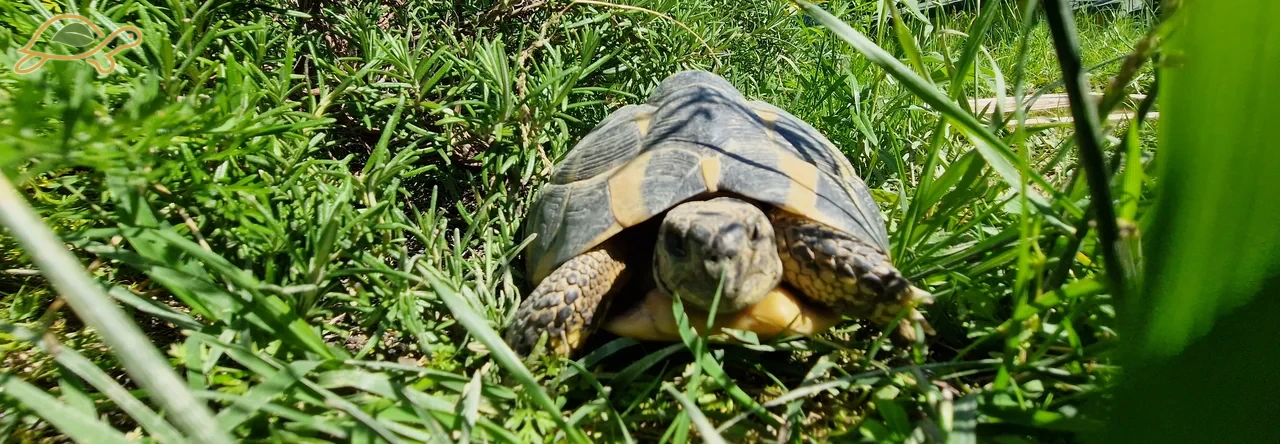
At the Sanctuary, we observed a contrast that made us think: beside areas of short-cut grass, almost like a formal lawn, we allowed more varied vegetation to grow, with tall grasses, shrubs and shaded corners. When we looked for the tortoises, we found them sheltered within that small green complexity, not on the mown lawn. This is an observation from our experience, not a rule valid for every animal at every moment. But it reminds us of something important for anyone keeping tortoises in a garden: cutting everything short to see them better, show them to guests or maintain perfect tidiness primarily serves our own gaze. It does not necessarily improve their environment. This is not about giving up garden care, but rethinking it to make room for variety, shelter and choice. The question guiding our project is simple: is this place merely pleasant for us to look at, or is it also good for the animal to live in?
Resources must genuinely be accessible
Temperature, humidity, substrate and access to resources also affect feeding. Where several animals live together, the presence of food or shelters does not prove that all can use them: competition and individual conditions must also be considered. [3]
“There is a shelter” and “this animal can use the shelter” are two different pieces of information. Attention to this detail is what makes an environmental description useful.
Living together does not necessarily mean living well together.
At the Pilot Sanctuary, we have observed competition between males and changes in interactions when an animal is introduced to a group. This experience has taught us to look not only at how many animals occupy a space, but at how each can use it.
We do not regard conflicts as something simply to let animals “sort out among themselves”. Bites, ramming and persistent mating behaviour can cause serious injuries. Risks are not limited to interactions between males. [4]
When managing groups, we therefore observe access to food, water and shelters, the ability to move away and any repeated chasing. Where cohabitation compromises safety or access to resources, the spatial arrangement must be changed and suitable separation provided. A new arrival also requires health assessments and veterinary guidance on quarantine: compatibility is not tested simply by placing animals together. [4]
What this means for the Sanctuary
The Foundation’s design principle is to connect space, needs and continuity of management. Every environment requires a specific assessment: observing how animals use it helps us ask the right questions.
For an institution interested in a similar project, the starting point is to gather relevant questions: which species, which local conditions, what expertise and what long-term responsibilities? Replicability begins here, not with copying a plan.
A mosaic to maintain, not a garden to abandon
Allowing taller vegetation does not mean abandoning management. In the Sanctuary project, we envisage covered areas alternating with accessible passages, sunny spots and shelters. Service routes allow checks and maintenance; less disturbed areas offer animals alternatives.
The same patch of ground changes throughout the day: shade moves, soil dries and vegetation grows. It therefore matters to observe which areas are used and under what conditions, without inferring a permanent preference from a single moment.
Water and shelters: being able to reach them matters too
In our experience, shallow stone drinking basins with gradual access make management easier. The material alone does not guarantee hygiene or safety: shape, stability, depth, cleaning and the ability to get out must be considered together. A shelter, too, must be accessible, maintained and monitored for its microclimate.
See the Pilot Sanctuary’s drinking basin and the choices for the new Sanctuary →

Understand. Respect. Protect.
Sources and limits of this article
Update of 10 September 2026: the passage “Pleasing to look at, or good to live in?” reports a direct observation shared by the Foundation. It is not an experimental study or a quantitative measure of animals’ preferences.
[1] IUCN/SSC Tortoise and Freshwater Turtle Specialist Group, Testudo hermanni (2011–2012 monograph)
Distribution, habitats and species overview; not an updated threat assessment.
[2] Smithsonian National Zoo, Reptile Discovery Center
Environments and behavioural opportunities appropriate to different species.
[3] Merck Veterinary Manual, Nutrition in Reptiles
The relationship between environment, light, temperature and nutrition.
Injuries arising from interactions between animals, quarantine and veterinary assessment. Consulted on 23 September 2026.
Sources for the original article consulted on 9 September 2026; additions on the Pilot Sanctuary’s experience and the Sanctuary project made on 22 September 2026; addition on informed care made on 23 September 2026. General educational information: it does not replace veterinary assessment of an individual animal.