Study Centre · The basics
For herbivorous Mediterranean tortoises, talking about food means talking about plants, variety and environment — not one ingredient that can solve everything.
In brief
This article concerns herbivorous tortoises: it is not a diet suitable for all turtles and tortoises, especially aquatic species.
Fibre is not filler
Herbivorous tortoises use fibre-rich plant foods. Digestion also involves microorganisms that help ferment plant material. Judging only how tender or appealing a food is therefore does not tell us whether it is suitable. [1]
It eats it. But is it good for it?
In conversations with people who keep tortoises, we have encountered an understandable misconception: if an animal willingly eats something, that food must be suitable for it. This is not the case.
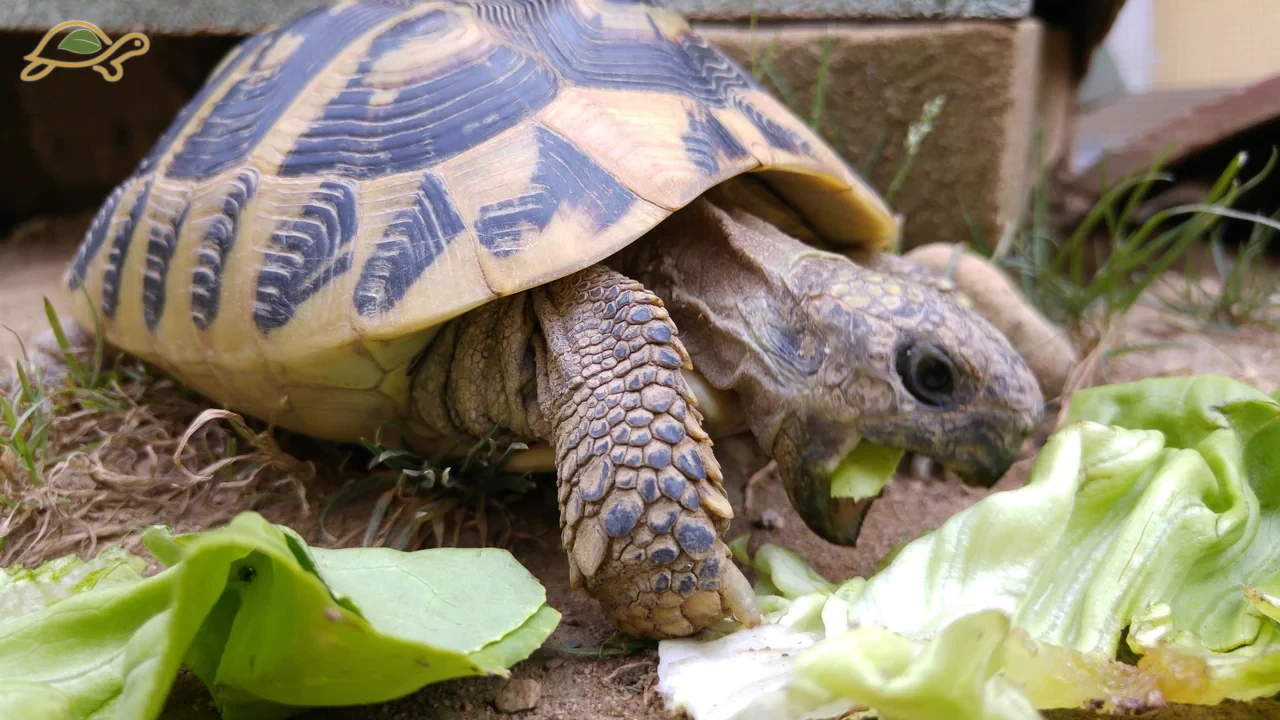
Testudo hermanni is a predominantly herbivorous tortoise. Bread, pizza and leftovers from our meals do not form an appropriate diet: the reference is a variety of species-appropriate, fibre-rich food plants, reliably identified and from checked sources. Not a miniature version of our own table. [3]
Variety does not mean collecting plants at random
Guidance for Mediterranean tortoises emphasises a variety of suitable plants. Reliable identification and attention to origin are essential, however: an unknown plant or one from a treated area is not safe merely because it looks natural. [2]
If you cannot identify a plant, do not improvise. Its correct name and a competent assessment are more useful than a resemblance found in a photograph.
A product does not replace assessment
The absence of obvious immediate problems does not prove that a diet is balanced. Nor does shell growth point to a single cause: nutrition, calcium availability, UVB exposure and environmental conditions interact in animal health. A deformity alone cannot reconstruct past mistakes or determine treatment. [4]
Learning beforehand is an act of protection. If you have concerns about diet, describe to the veterinarian the foods actually offered and the husbandry conditions. Do not independently compensate with high-dose supplements or assume that every existing change can be reversed by changing the menu.
Make the conversation with your veterinarian useful
Describe what you actually offer, how often and what is consumed. Include any products used and their labels. “It eats vegetables” is less informative than a precise list.
The aim is not to judge the person caring for the animal, but to provide useful information. If appetite changes, do not try to compensate with products or force-feeding without veterinary guidance.
Growing to nourish: distinguish plants’ purposes
For herbivorous Mediterranean tortoises, veterinary guidance favours a variety of suitable, fibre-rich plants. Dandelion and plantain are examples, not a complete menu: identification, origin and the animal’s condition remain essential. Sugary fruit should not be presented as a regular food for Testudo hermanni. Reference: Royal Veterinary College.
A plant may benefit pollinators or provide shade without being suitable for tortoise grazing. In the project, we therefore distinguish food plants, vegetative shelters and plants for biodiversity; species selection must also consider toxicity and accessibility.
What happens at the Pilot Sanctuary today
The Foundation supplements food because what grows naturally at the Pilot Sanctuary is insufficient. In the new project, growing some of the plants may help us know their origin and plan supplies. This is not a guarantee of self-sufficiency: production and requirements will need to be assessed over time.
Hydroponics also requires nutrients and management: a food’s quality cannot be inferred from its growing system alone. Read how we are addressing water and cultivation in the project.

Understand. Respect. Protect.
Sources and limits of this article
[1] Merck Veterinary Manual, Nutrition in Tortoises (2025 revision)
Plant fibre, digestion and nutritional assessment.
[2] British Chelonia Group, Care of Mediterranean Tortoises (archive)
Background reference for plant variety and safety; not a clinical protocol.
[3] Royal Veterinary College, Mediterranean Tortoise Care (December 2022)
Guidance for Mediterranean tortoises, to be read alongside source 1 on nutrition. Consulted on 23 September 2026.
[4] Merck Veterinary Manual, Nutritional, Metabolic, and Endocrine Diseases of Reptiles
Relationships between nutrition, UVB, environment and metabolic disease. Consulted on 23 September 2026.
Sources for the original article consulted on 9 September 2026; additions on the Pilot Sanctuary’s experience and the Sanctuary project made on 22 September 2026; addition on informed care made on 23 September 2026. General educational information: it does not replace veterinary assessment of an individual animal.